

 Brain Aneurysm Foundation
 Sarah Jean’s Story – Video
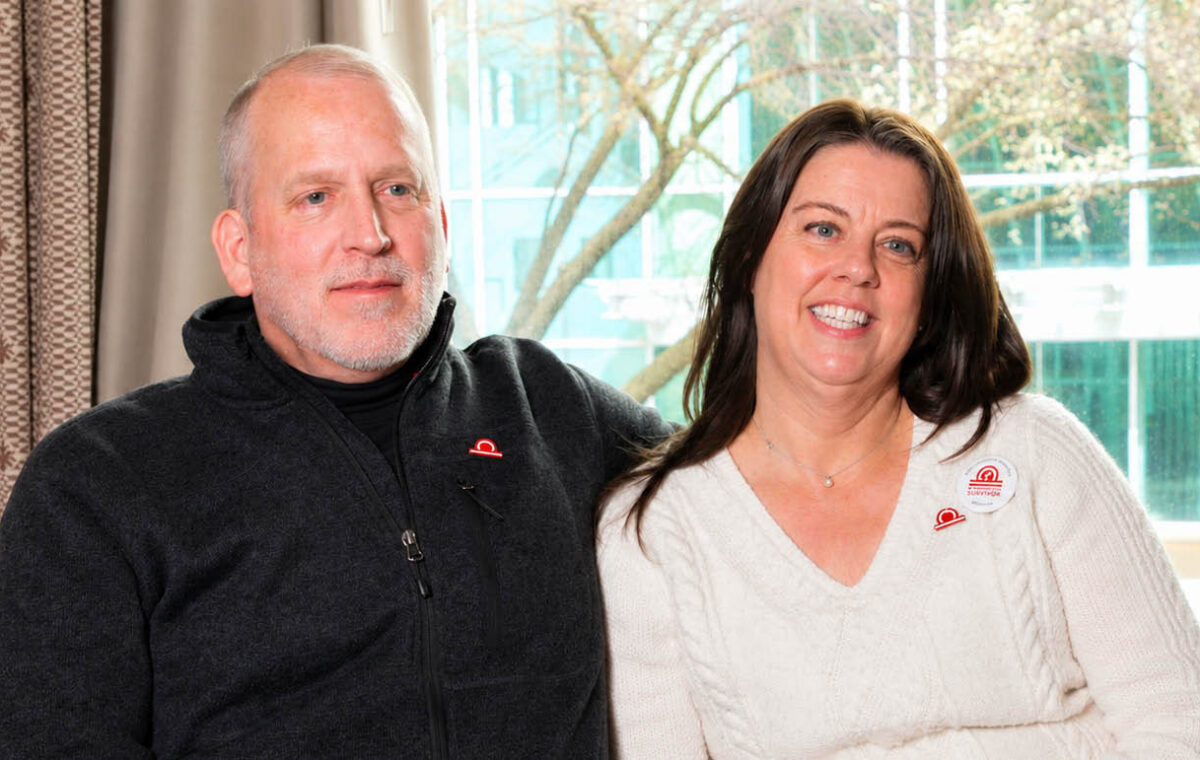
Sarah’Jean’s rapid diagnosis and successful treatment of a ruptured brain aneurysm, highlighting the critical role of immediate medical attention and the ongoing need for better screening, research, and access to care.
Video transcript:
Sarah Jean: I was actually working on a roof—on the roof of a detached garage—clearing off debris like you do. And suddenly, I had the worst headache of my life and knew something was horribly wrong. It wasn’t something like, “Oh, I’ll go lie down” or “I’ll take some medication.” This was different. Something was seriously wrong.
Scott helped me down and drove me to the hospital. Fortunately, UConn Health was very close by. My ER doctor quickly recognized that this was not a migraine, and I immediately got a scan. They detected a subarachnoid hemorrhage right away. From the moment of rupture to diagnosis, it was only 41 minutes.
I was oddly relieved. I thought, “Good—they know what it is. Now just open the textbook to that page and follow the instructions on how to fix this.”
In the meantime, Scott called our family, and everyone was with me in the ER as this was happening. Then I fell asleep and woke up in the ICU. I was alert for everything after that. When my neurosurgeon, Dr. Bulsara, came in after surgery, he said, “It went well. You were coiled. You’re going to be in the ICU for two weeks.” And I thought, “This is amazing—I don’t have to do anything for two weeks.” I almost thought of it like a spa.
I had no idea what was coming next—vasospasms, the risk of stroke. It should have been a red flag that they were checking me for signs of stroke every hour, on the hour.
I think the hardest part about going home was that I looked the same as I did before all of this happened. So people forget that you just experienced a traumatic brain event. I was in that very rare group with no visible deficits, but there were still things I couldn’t do that I knew I could do just two weeks before. I couldn’t process things the same way. There were moments where I thought, “I can’t even process this.”
I also had a heightened sensitivity to sound, so I had to wear noise-canceling headphones.
Scott: All the time. We had to avoid certain environments—normal things we used to do—because of the noise. Even simple decisions became complicated: which restaurant to go to, where to sit. These aren’t major issues in the grand scheme of things, but they were part of that long recovery.
Like you said, the things you take for granted before take on a completely different meaning afterward, for a long time.
Sarah Jean: I’m feeling pretty good now, and even more grateful—especially knowing what could have happened, beyond just surviving. When you learn about the range of possible outcomes, it really changes your perspective.
The more I hear stories from others—people who were dismissed, ignored, or sent home—I’m honestly flabbergasted.
Scott: Like many of the people here, we often hear the word “luck” come up. And let’s be honest—there’s a little bit of luck involved. But with the work of the foundation, with Ellie’s Law, and with increased funding for prevention, research, access, and treatment, we can’t rely on luck.
Luck is a terrible plan.
A much better plan is improved screening and earlier identification. A much better plan is more research into brain aneurysms. A better plan is broader access to care—so that it’s available to everyone.
That’s how we take luck out of the equation as much as possible.
Sarah is right—because we had access, because we were close to excellent care, that’s a major reason why she’s still here.